Product role
This is a finished grinding-aid product family, distinct from TIPA, TEA and DEIPA formulation raw materials. It is intended for controlled evaluation where the plant seeks higher stable throughput, lower specific grinding energy, improved cement flow or a defined quality target.
Information to confirm on the current TDS
| Product form | Liquid; exact appearance and grade to be confirmed. |
| Density, pH and solids | Confirm for the selected grade before pump calibration or dilution. |
| Chloride and alkali | Confirm from the current specification or COA; do not infer from another grade. |
| Dosage window | Establish by laboratory screening and full-scale mill trial. |
| Packaging / shelf life | Confirm for the selected grade and destination. |
Release gate before product selection
This page describes the finished-product family and the trial workflow. It does not assign a model, dosage, packaging, storage period or guaranteed performance value. Those fields are released only after the current grade-specific TDS and supporting quality documents have been confirmed.
Application and dosing
- Record the stable untreated baseline: t/h, kWh/t, Blaine, residue, mill temperature and cement strength.
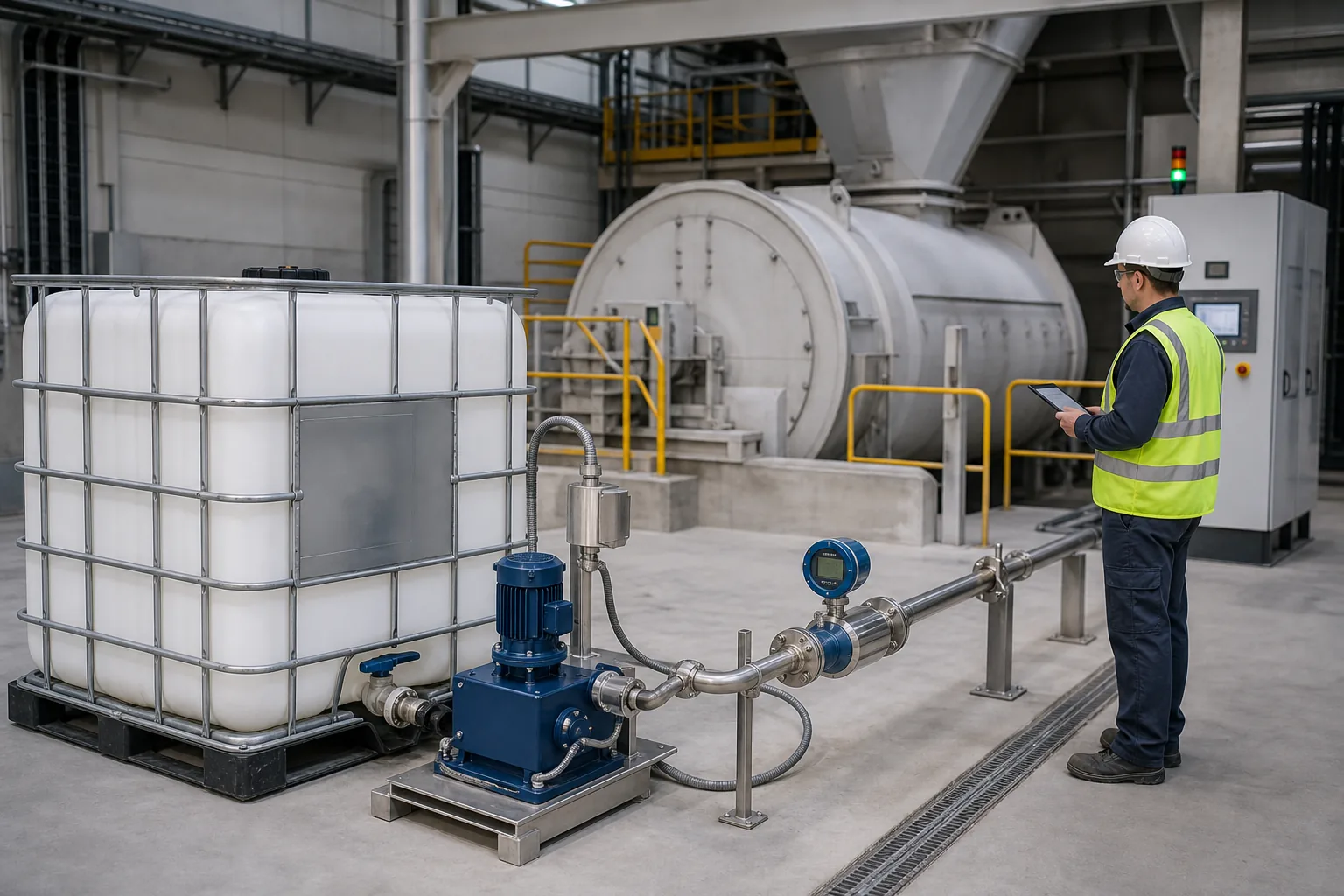
- Confirm product density and calibrate the dosing pump by mass or verified volumetric flow.
- Start with an agreed trial dosage and change only one principal variable at a time.
- Allow the circuit to reach stable condition before collecting a comparison sample.
- Evaluate process and quality results together before changing the dosage.
Use the dosage calculator for consumption planning and the mill-trial protocol for data collection.
What to measure
Grinding circuit
Output, total and specific power, separator condition, recirculating load, ventilation and temperature.
Cement quality
Blaine, residue, particle-size distribution where available, water demand, setting and strength.
Handling
Mill coating, pack-set tendency, silo discharge, conveying and bagging behavior.
How a controlled mill trial should progress
1. Freeze the baseline
Record feed, cement composition, mill and separator settings, output, power, fineness, temperature and quality results before changing dosage.
2. Change one variable
Use a calibrated dosing point and hold other operating variables as stable as practical. Record product mass and the dosage basis.
3. Wait for steady state
Allow sufficient circuit residence time before sampling. Label every sample by time, operating condition and dosage.
4. Compare the full result
Review throughput and kWh/t together with fineness, residue, setting, strength, flowability and handling—not a single metric.